
◆   Austin & nearby Central Texas communitiesResidential & commercial fencing · Custom decks
A landscaped Austin-area property with fencing or outdoor deck design
Home / Guides / Commercial Chain-Link Fence Specification Guide
GUIDES

Commercial Chain-Link Fence Specification Guide

Understand gauge, fabric, framework, gates, finishes and phased business access.

Planning resource: This guide provides general information. Check manufacturer specifications and the relevant municipality for your actual project, and compare written estimates.

Understand gauge, fabric, framework, gates, finishes and phased business access. Use these checkpoints when reviewing the specific property and a written contractor proposal.

PART 1

Define the site objective

A property manager should specify whether the fence is mainly for safety, storage control, security, animal containment or circulation. An open commercial perimeter is a different product than a privacy screen. The job may require coordination with fire access, delivery routes and adjacent public rights-of-way.

PART 2

Fabric and framework

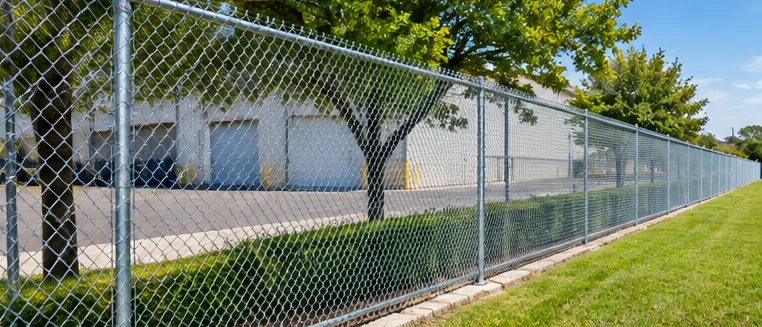
Chain-link assemblies vary by wire gauge, mesh opening, coating, framework diameter, wall thickness and connection details. Ask for exact manufacturer or industry specifications instead of accepting “commercial grade” as a complete description. Post spacing, corner and terminal posts, top rail, tension wire and bracing are part of the system.
Illustrative material or construction detail
PART 3

Galvanized or coated finishes

Galvanized steel and polymer-coated chain-link products have different visual and corrosion-resistance properties. The coating on fittings, rails and posts should be consistent with the fabric. Evaluate exposure to irrigation, moisture, chemicals and high-contact areas.

PART 4

Pedestrian and vehicle gates

Specify opening dimensions, daily use, latching, hinges, wheel supports if needed, crash or damage exposure, access control and emergency egress. Powered gates are a specialist system requiring separate safety review. A high-use gate should be treated as a separate performance element in the estimate.

PART 5

Commercial project coordination

Site operators may need to keep entrances, loading docks or parking lanes open. Document phases, working hours, temporary perimeter arrangements, utility access and safety controls. Ask for clear responsibilities around approvals, drawings, insurance and final acceptance.

Illustrative material or construction detail
PART 6

Bid comparison worksheet

Compare bids with equal assumptions about gauge, posts, concrete, coating, gate hardware, demolition, disposal, work hours, security constraints and repair availability. A basic installed cost per foot cannot represent all commercial conditions.

Frequently asked questions

Can chain link be used at multifamily buildings?

Often, but local zoning, access, design and safety rules must be checked.

Is coated chain link maintenance-free?

No. Hardware, coating, damage and gate operation still require inspections.

Does a power gate require special planning?

Yes. Treat powered access as an engineered and safety-regulated system.

IN-DEPTH PLANNING

Details that are often missed in a quick estimate.

What “commercial grade” does not tell you

The phrase alone does not disclose wire diameter, mesh size, zinc or polymer coating, framework size, post spacing, terminal bracing or gate specification. Ask bidders to write these values into the proposal and identify substitutions. Two bids that both say “chain link” can represent very different intended service lives and installation effort. For a large property, request a site plan with numbered fence runs and a separate gate schedule rather than a single undifferentiated footage figure.

Treat corners and gates as special elements

Terminal posts, directional changes and gate openings often carry different loads than line posts. A perimeter with many corners or heavy vehicle gates can require substantially more structure than a straight run of equivalent length. Consider how vehicles turn, where emergency access is required, and whether an active gate leaf can be locked open safely. Powered gates introduce additional operator and safety requirements that should be evaluated separately by qualified personnel.

Plan work around occupancy

A warehouse, multifamily complex or retail property may need to remain in use during construction. Document which entrances will be obstructed, how deliveries will proceed, and whether temporary protection is needed. Give all bidders the same working-hour and access constraints. In the final handoff, inspect fabric tension, fittings, gate alignment, clearances, exposed fasteners and coating damage, then receive maintenance instructions and the actual warranty terms.

NEXT STEP

Ready to plan your project?

Tell us about the property, materials and project goals so the details can be reviewed in one place.

Request a project estimate ↗
Call nowGet an estimate